What is Clay Art?
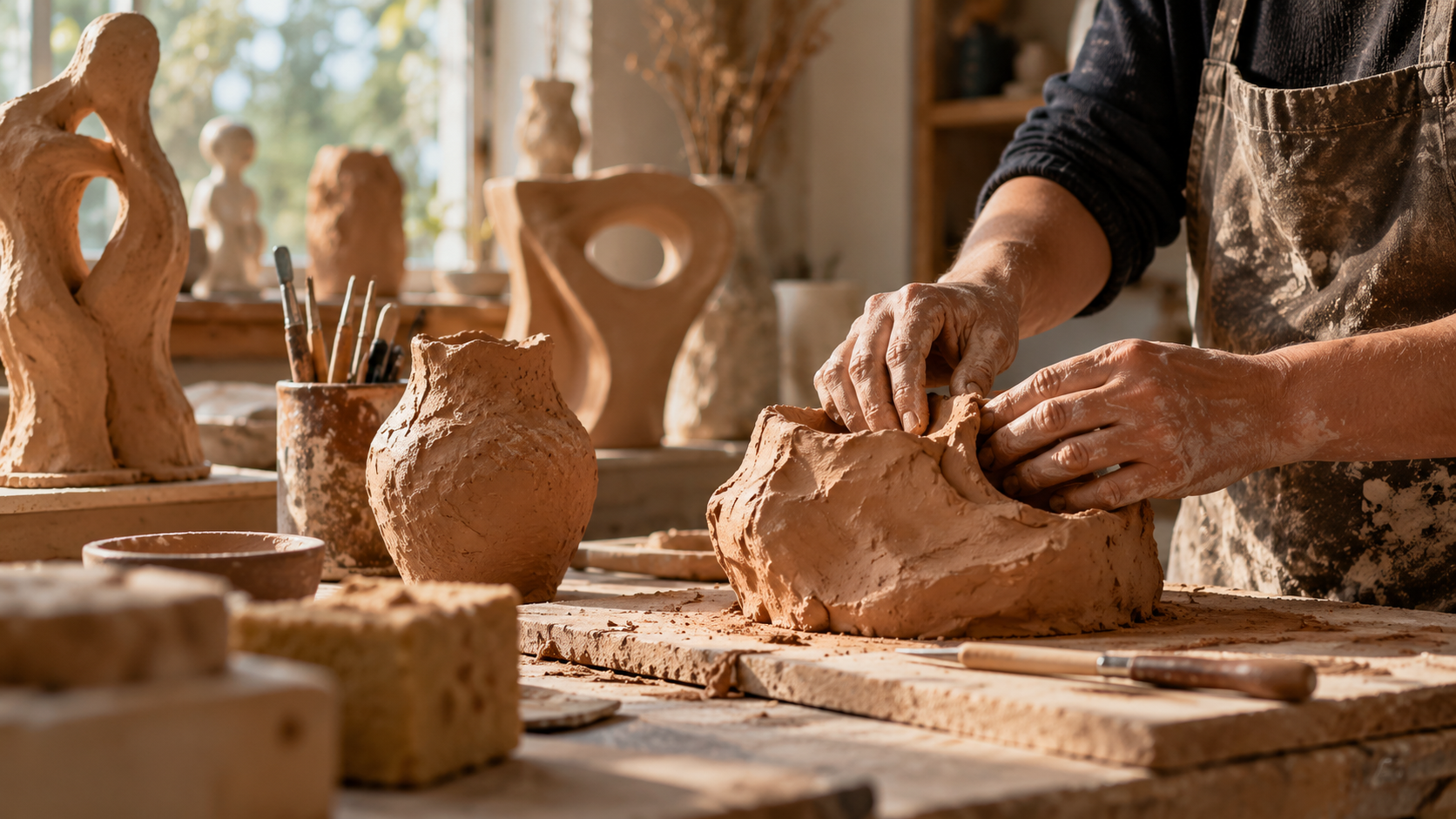
Clay is one of the oldest materials humans have used to make things, and it remains one of the most versatile. Unlike paint, which is applied to a surface, clay gives an artist the opportunity to create something that has a physical form. It can be shaped, stretched, carved, textured and built up before being transformed by heat.
For many people, clay is associated with pottery: bowls, plates, cups and vases. But clay can be much more than that. Artists use it to create figures, animals, abstract forms and large sculptural pieces. Some pieces may be carefully planned, while others develop almost spontaneously as the artist works with the material.
One of the fascinating things about clay is that it allows the artist to work in three dimensions. Instead of deciding what something should look like on a flat surface, the artist has to consider it from every direction. A curve that looks right from the front might look completely different from the side.
There are several ways of working with clay. It can be built up by hand using techniques such as coiling or pinching, constructed from flat slabs, or shaped on a pottery wheel. Artists can also carve into clay, press textures into it or combine different forms to create more complicated structures.
Clay also has an unusual relationship with time. When it is first shaped, it remains relatively soft and changeable. It can be altered, reshaped or completely started again. But once it has been fired in a kiln, the transformation is largely permanent. What began as soft earth has become a hard, durable object.
Glazes and other surface treatments can add another dimension. Colour, texture and patterns can change dramatically when a piece is fired, meaning that the final result isn’t always completely predictable. For some artists, that element of uncertainty is part of the attraction.
Clay also doesn’t have to be perfectly finished. Cracks, fingerprints, rough surfaces and irregular shapes can all become part of the artwork. Sometimes the evidence of the artist’s hands is just as interesting as the finished form.
Today, artists continue to experiment with clay in ways that move well beyond traditional pottery. It can be combined with other materials, used to create highly detailed sculpture, or deliberately left raw and unfinished. The material may be ancient, but there is nothing particularly old-fashioned about what can be done with it.
Perhaps that’s why clay has survived as an artistic medium for so long. It is simple enough to pick up and start shaping with your hands, but versatile enough that an artist can spend a lifetime exploring what it can do.
From a simple lump of earth, almost anything can emerge.